
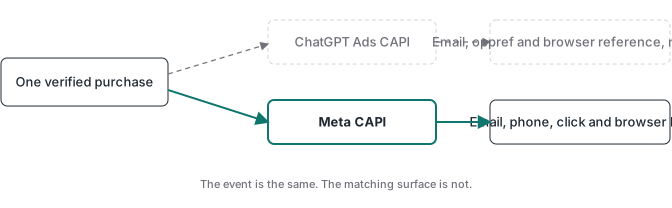
If you already send verified purchases to Meta’s Conversions API, adding OpenAI’s is mostly an adapter on the same event: the source, the consent decision and the event ID carry over. The payload does not. This page covers the differences that matter when one order feeds both, and leaves the setup of each platform to its own guide: ChatGPT Ads conversion tracking and Meta CAPI fundamentals.
An earlier version of this page said OpenAI rejects phone hashes and does not serve the EU. Both were true when it was published on 10 August 2026 and are not now: OpenAI accepts phone_numbers_sha256, and European markets opened that month. What still differs is less visible and bites harder: time units, list fields, and how each platform treats a resent server event.
How we run both from one server container
On the Advanced Tracking Academy checkout, the OpenAI conversions tag added on 6 August 2026 is a copy of our Meta conversions tag with a different payload. Both fire on the same Stripe webhook trigger. Both read their identifiers from the same Stape Store document, where _fbc and _fbp already sat and oppref and obref were added beside them. Both reuse the event ID our web container already shares with the Meta pixel.
That is the shape I would recommend: one verified conversion record, one consent decision, then a branch per destination at the last step. The server-side GTM build notes show the Store fields.
The field map
Checked against Meta’s server event parameters and OpenAI’s Conversions API on 2026-10-17:
| Concept | Meta CAPI | OpenAI Conversions API |
|---|---|---|
| Event time | event_time, Unix seconds, GMT |
timestamp_ms, Unix milliseconds |
| Oldest accepted event | 7 days; one older event fails the request | 7 days, and no more than 10 minutes ahead |
| Event ID | event_id |
id (pixel side: event_id) |
| Click reference | fbc, inside user_data |
oppref, at event level, original string |
| Browser reference | fbp, inside user_data |
obref from __obref, inside user |
em, hashed |
emails_sha256, list of up to 3 |
|
| Phone | ph, hashed |
phone_numbers_sha256, list of up to 3 |
| External ID | external_id |
external_ids_sha256; trim, keep case, then hash |
| Too many list values | n/a | HTTP 400, nothing truncated |
The two units are the easiest bug to ship. Same instant, different number:
const occurredMs = Date.parse(order.paid_at);          // one source of truth
const meta   = { event_time: Math.floor(occurredMs / 1000) };
const openai = { timestamp_ms: occurredMs };
An adapter that copies one value into both fields sends one of them a time 1,000 times too large or too small, far outside the window that API accepts.
The 7-day limit is shared, not an OpenAI quirk. Meta’s parameter page says event_time “can be up to 7 days before you send an event”, and older events fail the whole request. If a retry queue holds events longer than a week, both destinations lose them.
Resending a server event
Both platforms deduplicate a browser copy against a server copy that share an ID and event name. Only OpenAI documents what happens when the server sends the same event twice.
OpenAI tells you to “reuse the same ID when retrying”, and its deduplication rule keeps the first event received for a Pixel ID, event name and ID and ignores later copies. A resend with the same ID is harmless there.
Meta’s deduplication page does not say what happens to two server events with the same event_id (checked 2026-10-17). Its warning that it “does not deduplicate events when only using one event source” sits under the alternative fbp/external_id method, so it does not settle an event_id resend. We have not run a controlled resend test either.
So our retry queue does not lean on either platform’s deduplication. It keeps one stable event ID per order and records which events each destination already accepted, so it never resends a Meta event that already got a success response. That costs little and holds whatever Meta does with a duplicate.
Which copy wins
Both platforms prefer the first copy they receive. Meta says it “generally” keeps the first; OpenAI states it as the rule. For a purchase, that makes the browser copy dangerous on both: a thank-you page that fires before the payment webhook wins, and the verified server event is the one dropped.
The fix is the same on both sides. Fire the browser purchase only after payment is confirmed, or send a checkout event from the browser and the purchase only from the server. On our checkout, the OpenAI web tags stop at checkout_started for this reason.
Phone numbers and audience files
Both conversion APIs now take a hashed phone number built from digits with the country code and no +. OpenAI’s own example turns +1 (415) 555-2671 into 14155552671 before hashing.
The trap is on the OpenAI side, between two of its own workflows. Custom audience files hash phone numbers in E.164 with the + kept, so the same customer produces one hash in an audience file and a different one in a conversion event. Write two normalizers and name them, rather than one shared helper.
Geography is a buying question, not a payload one. OpenAI listed more than 60 countries in September 2026, including the EU, Brazil and Mexico; the dated line and its sources are in the conversion tracking guide. Your consent logic sits before both branches either way, and a newer channel does not get a looser path.
The ATA Toolkit targets this branching problem: one verified server-side event with a controlled route into each ad platform. ATA Edge covers the Meta route today.