
Server-side tracking does not recover a fixed percentage of events. Three reports shared in private practitioner groups I belong to show how wide the range is. A team said its Stape-hosted container sent about 15% more events than the browser the day after it added Stape’s Custom Loader. A media buyer whose delivery was mostly iPhone said more than 70% of web events were blocked. A PageView screenshot showed 8,555 server deliveries against 3,251 browser deliveries. The groups are private, so I can’t link the posts.
Those numbers come from different sites, traffic mixes, event rules and measurement screens. They show that browser loss can be material. They cannot tell you your number. The recovery figure that supports a decision is the count of valid, unique business actions that reach a platform only because the server path exists, with consent respected and duplicates removed.
This article gives you the method first, then what each reported number can and cannot support. If you need the architecture, read what server-side tracking is first.
Four numbers describe recovery
Start with a business event that has an independent ledger. Purchase is easier than PageView, because the payment processor or order database gives you a count and a transaction ID for every action. Then define:
- N: eligible actions in the ledger for the period (paid orders, after removing test and internal orders).
- B: unique actions from N that the platform received through the browser path.
- C: unique actions from N that the platform received through browser plus server, after deduplication.
From those, four metrics answer four different questions:
| Metric | Formula | Answers |
|---|---|---|
| Browser coverage | B / N | How much the browser path delivers alone |
| Combined coverage | C / N | How much reaches the platform now |
| Incremental coverage | (C − B) / N | How many points of coverage the server path added |
| Relative uplift | (C − B) / B | How much larger the delivered count got |
An illustrative example, not client data: N = 1,000 paid orders, B = 640 and C = 870 give browser coverage of 64%, combined coverage of 87%, incremental coverage of 23 points and a relative uplift of 35.9%. Reports that quote “server-side recovered 36%” and “server-side recovered 23%” can be describing the same setup.
Match on IDs, not on totals. Join each destination event to the ledger by transaction or order ID, count each ID once, and keep events that match no ledger row in a separate column. Investigate ID mapping, timing and ledger completeness before you classify them: an unmatched event can be a duplicate, a test or a false conversion, but also a malformed ID, a ledger row that hasn’t landed yet or an order just across the period boundary. Adding them to C inflates every metric.
Coverage is also how you catch a broken server path
The same ratio, measured every day, is a monitor. In September 2026, a high-volume Brazilian client we monitor had a server container that stored each visitor’s browser context under their email and read it back under the email in the payment webhook. The site began pushing the email to its data layer as a SHA-256 hash. New records were written under the hash, the webhook kept reading under the plain address, and every lookup returned empty with no error anywhere.
GA4 discards a Measurement Protocol hit without a client ID, so GA4 purchase coverage against bank deposits went from about 97% to 67%, then 26%, then 18% on three consecutive days. Pixels kept firing, the server’s outgoing requests kept getting 200 responses, and the bank side stayed normal. The daily coverage check is what paged.
Two lessons carry over to any recovery measurement. Key server-side joins on an opaque ID that both sides carry unchanged, never on a browser field such as email. And judge coverage daily, with a margin, instead of waiting for a monthly report.
Deduplication works differently per destination
Combined coverage only means something if one action stays one conversion. The rule depends on the platform.
For Meta, a browser event and a server event deduplicate when the pixel’s event matches the server’s event_name and the pixel’s eventID matches the server’s event_id, received within 48 hours (Meta deduplication docs, checked 2026-10-17). Meta generally keeps the event it received first. Meta documents this as matching a browser event with a server event; for its fbp and external_id method it says outright that it “does not deduplicate events when only using one event source”. So a server-only Purchase sent twice, for example by a webhook retry, should be treated as two conversions unless your own code prevents the second send. TikTok’s browser and server pairing also relies on a shared event ID.
For GA4, the normal server-side setup has one path: the web Google tag sends to the server container, and the server forwards to GA4. GA4 deduplicates purchases by transaction_id on web streams (Google Analytics Help) and has no general event ID deduplication, so a parallel browser GA4 tag would double every other event.
Read browser and server counts at the source
For Meta, the dataset’s stats edge in the Graph API returns hourly counts per event name and per source, BROWSER or SERVER. When we checked an ad-view event on our own site on 2026-10-07, our sampled edge log was missing a row in two of three test runs while Meta’s per-source counts showed every event, about an hour late. So trust the platform’s counts over a sampled log for volume.
Those counts are aggregates, though. They tell you how many events arrived per source, not which ledger orders they belong to or whether each one is unique, so they can’t stand in for B or C. Use them as a volume diagnostic. Compute B and C from eligible, uniquely identified actions with a receipt you can tie to each order ID (your own delivery log keyed by order, or a destination export at that level). If all you have is aggregate counts, say that reconciled recovery can’t be calculated from them.
Same-period, ID-joined comparisons beat before and after
A before-and-after comparison is tempting: measure a month without the server path, add it, measure another month. Traffic mix, consent rates, campaigns and code changes move between the two periods, so the difference cannot isolate what the server added.
Prefer one period, both paths running, joined on stable action IDs. For each ledger ID, record whether the browser event arrived, whether the server event arrived, and whether the destination kept one copy. B and C then come from the same orders. Use before-and-after only when you cannot tag each path separately, and report it as an observational coverage change, not a recovery count.
Use this audit sequence:
- Pick one event and freeze its definition.
- Record the ledger denominator N and its IDs.
- Confirm the browser and server copies share the identifiers the destination deduplicates on.
- Run a real control event through both paths and inspect the requests.
- Check destination-side receipt and deduplication. HTTP acceptance covers only the sender’s delivery attempt.
- Compute the four metrics for the same window.
- Break the gap down by device, browser, consent state and traffic source.
- Repeat after enough volume that one day cannot drive the conclusion.
For an implementation pattern, the server-side GTM guide explains how the web container sends a single stream to the server container, and the Meta Conversions API with GTM guide covers the difference between delivery, matching, deduplication and attribution.
Three reported numbers and what they support
None of these three cases is a reconciliation I ran. They are reports from other operators, kept here with their limits because they show how different the gap can be.
| Reported case | Reported result | What it can support | What it cannot support |
|---|---|---|---|
| PageView screenshot shared in a practitioner group | 8,555 server vs 3,251 browser deliveries | A large source gap existed on that screen | Platform screen and interval were not supplied, so this cannot establish 5,304 unique visitors or a rate |
| Tracking team's post in a practitioner group, July 2026, a day after adding Stape's Custom Loader | About 15% more server events than browser events | A moderate gap can matter at scale | One day, no raw rows or sample size, so this cannot isolate Custom Loader as the cause |
| Media buyer's report in a practitioner group, June 2026, on mostly-iPhone delivery | More than 70% of web events blocked | A severe mobile-heavy case can exist | Sample size and interval were not reported, so this is not an iOS average or forecast |
8,555 server events against 3,251 browser events
The screenshot, shared in a private practitioner group in August 2026, showed one PageView with 8,555 events attributed to the server source and 3,251 to the browser source. The platform screen, the interval and whether the counts came before or after deduplication were not supplied with it. The lines differ by 5,304 deliveries, and the server count is about 163% higher than the browser count.
To test whether a gap like this is recovery, confirm that both paths use the same PageView definition and time window, then inspect shared event IDs and the platform’s deduplication result. Different triggers, duplicate server requests, time-zone boundaries, filters, or a browser tag that failed for reasons unrelated to privacy can all widen it.
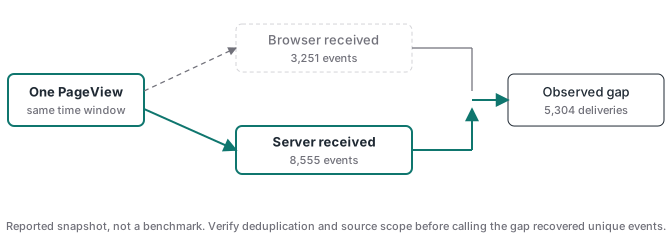
The ratio still tells the implementer where to look. If the server line is much larger, inspect blocking, loader delivery, mobile mix and server-only sources. If the browser line is larger, check transport from the web container to the server, server availability, consent handling and tag failures.
A Stape setup that reported about 15%
On 2026-07-10 a tracking team posted a screenshot in a practitioner group I’m in. They had run their Stape-hosted container without Stape’s Custom Loader, installed it the day before, and saw the server sending about 15% more events than the browser. That is one day after one change, without raw rows. Server routing, first-party script delivery, browser mix and tag logic were all running together, so the 15% belongs to the whole setup on that day. To isolate the loader, keep tag logic, consent behavior and server routing stable, annotate the activation date, and compare the loader’s own metric before and after.
Stape now offers that metric directly. Its Analytics dashboard reports the number and percentage of requests recovered from ad blockers by Custom Loader, and excludes offline server-to-server traffic such as CRM or payment webhooks. Stape’s Custom Loader documentation says the loader “minimizes the impact of ad blockers on your GTM and GA4 scripts” by loading them from a first-party domain. After enabling it, verify the custom route returns successfully, remove any standard loader running beside it, and keep recovered PageView requests, sales and attributed conversions as separate measurements. Reconcile webhooks in their own row.
An iPhone-heavy report above 70%
In June 2026, a media buyer in a practitioner group said web-event blocking exceeded 70% on a product whose delivery went mostly to iPhone users. Several filters can stack there: browser tracking prevention, content blockers, standard script URLs caught by lists, consent denial, in-app browsers and slow pages that users leave before a tag runs. Apple’s WebKit tracking-prevention documentation confirms that Safari blocks third-party cookies by default, deletes script-writable storage after 7 days without interaction and caps JavaScript cookies when it detects qualifying link decoration. Apple publishes no 70% figure.
Split your own measurement by browser and device. Compare iOS with Android and desktop over the same dates, campaign mix and landing pages. A large iOS gap may point to loader blocking or storage loss. It may also reveal a slower mobile page, a consent banner that behaves differently or an in-app browser problem.
What the server path can recover, and what stays lost
Server-side tracking recovers delivery when a valid event can reach a first-party endpoint, or originate in a backend system, even though the browser-to-platform call fails. Google’s server-side tagging fundamentals describe the server container as a buffer that can validate, parse, modify or block requests before forwarding them. That control can improve data quality. It does not make missing consent, invented customer data or false business events acceptable.
Think in failure classes:
- Blocked loader or request: a first-party loader and endpoint may restore delivery.
- Browser closes before the event: a signed payment or CRM webhook may provide the later event.
- Identifier expires or disappears: first-party server-set storage may improve continuity within policy and consent limits.
- Bad trigger or mapping: the server path repeats the error until the implementation is fixed.
- Duplicate browser and server copies: the identifiers each destination deduplicates on must match.
- False conversion: only reconciliation with the order system or CRM can reject it.
If the browser never created the event and no backend system observed the action, the server has nothing truthful to recover. If the visitor denied the relevant consent, the server path must honor that choice. The Event Match Quality guide covers a related distinction: better identifiers help a destination match an event, but you still need separate evidence that it happened once and was a paid order.
For most web measurement, keep a thin browser path for page context, consent interaction and click IDs, and add the server path with deduplication. A backend-only setup can be right for payment or CRM events, as long as the browser context it needs was stored at collection time.
The method on this page needs no particular product. ATA Edge packages webhook validation for Meta purchases today, and new GTM containers with the browser and server structure, deduplication and this test sequence are in development.