
When a web GTM tag fires but the server container is empty, the trigger is only the first receipt. It proves that the web container ran a tag. It does not prove where the browser sent the request, whether an sGTM client claimed it, or whether GA4 accepted and reported it.
The fastest fix is to debug those layers in order. Check the Google tag routing first, then search for a second hard-coded gtag using the same G- ID. After that, verify the request host and status in the browser, the claiming client in server Preview, and the GA4 property terms. Each layer gets its own receipt before you touch the next one, because a plausible check on the wrong layer can keep you editing tags that were never the problem. Advanced Tracking Academy uses the same receipt-by-receipt method when validating a server-side GTM setup.
A fired web tag says nothing about where the request went
A web tag can fire perfectly and still send its request somewhere other than your server container. Web Preview reports container execution: the trigger matched, variables resolved and the tag ran. That’s all.
The first useful evidence is the outgoing request in the browser Network panel. Trigger one test event, open its request, and read the host and the status. If it goes directly to a Google collection domain, the routing problem is still in the page or the web container. If it is addressed to your first-party tagging hostname, the browser used the route you configured. A 2xx status plus the request showing up in server Preview proves it arrived. Otherwise a green web Preview badge can keep you editing server tags that never received anything.
A request can also reach sGTM, get claimed, and still fail later at the outbound tag or the destination. One screen cannot prove the whole chain.
The route belongs on the Google tag configuration
Google’s Tag Manager Help (checked 2026-10-17) adds server_container_url directly as a configuration parameter on the Google tag. The send-data guide (updated 2026-10-13, checked 2026-10-17) puts the same parameter in a reusable variable, which is easier to share across tags. In the web container, create a user-defined variable of type “Google tag: Configuration settings”. Add the parameter server_container_url with your server container URL as the value. Select that variable in the Configuration settings of the Google tag or of the Google Analytics destination tag, and fire that tag on the Initialization - All Pages trigger so the route is in place before other tags run.
Variable type: Google tag: Configuration settings
Parameter:     server_container_url
Value:         https://data.example.com

Google tag (or GA destination tag)
  Configuration settings variable: the variable above
  Trigger: Initialization - All Pages
A GA4 Event tag sits downstream of that configuration. It supplies the event name and event-level parameters, so it is the wrong place to set the shared transport. If you add a server address to one event tag only, web Preview may show that tag as fired while page views and other events follow the direct route. Test the network request instead of assuming the setting propagated.
transport_url is the older label for the same route
You will still find transport_url in old tutorials, variables, community answers and some non-native tag templates. It answers the same practical question: which endpoint receives the browser request? Google’s current documentation for the native Google tag and gtag.js uses server_container_url.
The two names coexist in real containers. In a travel client’s web container I exported in October 2026, the Google tag set server_container_url from a variable still named transport_url, and the GA4 event tags for generate_lead and view_item inherited the route from the Google tag. That setup was correct. The variable’s name was a leftover; the parameter it fed was current.
Do not swap parameter names by memory. Open the exact tag template you are using and check which field it consumes. Then prove the result by inspecting the request host, which settles the terminology argument without guessing which blog post was written for which interface version.
A hard-coded gtag can take over the same G ID
A hard-coded Google tag, a CMS integration or a plugin can configure the same G- ID outside GTM. Google’s troubleshooting guidance says to use either the Google tag snippet or Tag Manager and warns that using both can overcount. Configuring the same Google tag more than once on a page can also produce duplicate data or mixed settings. In an sGTM migration the extra snippet creates the more confusing version: some events use the server route while another configuration sends directly to Google. The symptom looks random until you group requests by initiator and hostname.
Search more than the visible page template. Check rendered source, theme settings, consent-management integrations, analytics plugins, checkout scripts, injected header code and tag-management features built into the CMS. In Developer Tools, the Initiator column often exposes the script that created the request. Remove the duplicate only after you know which implementation owns consent and every required destination. On Shopify, the extra owner may be the Google & YouTube app rather than theme code; the Shopify duplicate-events audit separates GA4 tracking from the Merchant Center feed before removing anything.
Prove the browser request reached sGTM
Open Developer Tools before you trigger the event. Filter Network for collect, the event name or your tagging hostname, clear the list, perform one action and inspect the fresh request. Record the request URL, host, status, payload, initiator and time so the next person can reproduce what you saw. The host must be the server container URL you configured.
A healthy health check proves only that the service is up. Google’s Cloud Run setup guide documents the path as /healthy, which answers ok. When we retired the server container on one of our own content sites in October 2026, the last 24 hours of Cloudflare analytics on its two tagging hostnames showed 2,871 requests to /healthy, all from our uptime probe. The site had already stopped sending events there. From the health check alone, a working stream and an empty one look the same.
A successful request to a Google collection domain proves direct delivery and gives you no evidence of server delivery. If no request appears at all, return to the web trigger, consent state, browser errors and Content Security Policy. Google’s Tag Manager CSP guide lists the img-src, connect-src and frame-src entries the Google tag needs; once the tag sends to your tagging server, that hostname needs the same allowances. Keep the console open while testing. The exact browser error is more useful than changing several tags at once.
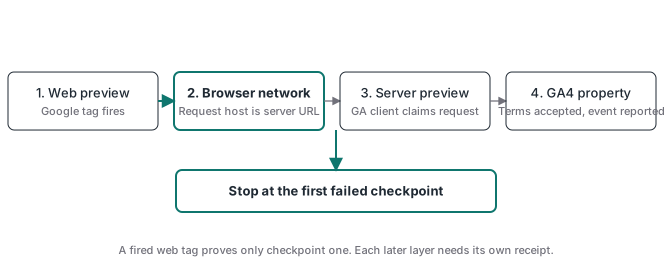
An empty server Preview with the right host has four usual causes
Start Preview from the server container, leave the debugger open, reload the website in another tab and trigger the event while both windows stay visible. The server debugger does not ask for a website URL, because it waits for requests arriving at the tagging server. When a request appears, check which client claimed it and which event the client created.
If the Network panel shows the correct host and status but server Preview shows nothing, work through these:
- Trigger the event in the same browser profile where you opened server Preview. Requests from other browsers, backends, webhooks or curl only show up when they carry the
X-Gtm-Server-Previewheader, copied from the server Preview menu under “Send requests manually”. Stape documents this flow and says to remove the header after testing, since its value changes. - Check the container’s server URL in the server container settings. It must match the host the browser is calling.
- On self-hosted setups, make sure the preview server is running and the tagging server knows where it is. Google’s Cloud Run deploy example sets this with the
PREVIEW_SERVER_URLenvironment variable on the tagging service. Live traffic can flow normally while the preview link is broken, so a blank Preview here says nothing about production. - Reconnect Preview after publishing a new server version or redeploying, then repeat the test.
If Preview shows a request but no event, inspect client claiming. Clients run in priority order, and the first one to claim a request stops the rest (server-side tagging introduction). A request on the wrong path, an incompatible payload, a disabled client or a higher-priority custom client can leave your GA4 client with nothing. If an event exists but the server tag does not fire, move to its trigger and variables.
Unaccepted GA4 terms make the destination look empty
This is a destination check. Google’s GA4 tagging page says you must accept the Google Analytics Terms of Service before a Google tag can send data to your account. That does not explain an empty server Preview, which sits earlier in the chain. It can explain why sGTM receives and processes an event while the GA4 property still shows nothing. Use an account with the required permissions, open the property and confirm the terms were accepted. Then check the property, web stream, measurement ID, Realtime report and processing delay.
Do not confuse this with the separate user-data collection acknowledgment used for advertising audiences and user-provided data. If GA4 receives the event but the number later becomes a key event or an Ads conversion issue, the GA4 conversion tracking guide continues from that layer.
The complete sGTM debug ladder
The ladder goes from the earliest observable fact to the final report. Run one test event with a unique value where possible, keep the time visible and save one receipt at each step. Stop as soon as a checkpoint fails, fix that layer, publish the relevant change and repeat from the top. This keeps a routing defect from turning into hours of edits to server tags or GA4 settings.
| Checkpoint | Evidence to capture | If it fails |
|---|---|---|
| Web execution | Google tag and event tag in web Preview | Fix trigger, consent, variables, or runtime error |
| Browser transport | Request host equals your server container URL, with a 2xx status | Fix server_container_url, duplicate code, CSP, or hostname |
| Server receipt | Incoming request visible in server Preview | Same profile, container URL, preview server, or preview header |
| Client claim | Expected client claims request and creates event | Fix client activation, priority, path, or payload format |
| Server tag | Outbound GA4 tag fires with the intended measurement ID | Fix trigger, variables, permissions, or tag configuration |
| GA4 acceptance | Terms accepted and the property can receive tag data | Accept terms with an authorized account and verify the property |
| Destination report | Test appears in Realtime or DebugView after processing | Check stream ID, filters, consent, payload, and processing delay |
Change one thing per pass and keep the previous known-good receipt. If two requests share the same G- ID, label their initiators before deleting either one. Record the container version. That small log lets another implementer reproduce a change in server Preview after a publish.
For a durable receipt after Preview closes, the sGTM event database guide logs selected events in Postgres, counts writes by event ID and keeps a duplicate row from masking an upstream duplicate source.
Make the route part of the deployment checklist
Give each G- ID one named owner, record one server hostname, and keep one screenshot or request export proving the browser used it. Publish web and server container versions with matching notes. Run a control page view and one business event, then save the browser request, the server claim, the outbound request and the destination receipt. The next incident starts from four facts instead of memory.
A managed first-party host such as Stape (affiliate link, ATA may earn a commission) can take care of the custom domain and container hosting. It cannot choose the correct Google tag, remove a hard-coded duplicate, accept GA4 terms or prove your event definition.
The ATA Tracking Toolkit membership includes a library of server GTM containers as a bonus. New containers with the web and server pieces, webhook validation and this test sequence are in development.
For a shared affiliate container, the multi-tenant sGTM routing guide adds exact partner lookups and negative tests for events that must produce no affiliate request.